AI writing tools no longer sit on the sidelines of marketing teams. They show up in planning meetings, draft outlines, and editing rounds. Quietly, but consistently.
For many copywriters, this shift feels practical and unsettling at the same time. AI speeds things up. It removes friction. It also raises an uncomfortable question about where human judgment still fits.
That tension is where most teams now operate.
AI Has Moved Into the Everyday Workflow
A few years ago, AI tools felt experimental. Today, they feel routine.
Writers use them to explore angles, test headlines, tighten copy, or summarise long research documents before the real work begins. Not because AI is better at writing, but because it reduces the time spent staring at a blank page.
The tools themselves are not interchangeable. Some are better for structure. Others for tone. Most copywriters settle on a small stack and learn how each behaves under pressure.
What matters is not how many tools you use, but how deliberately you use them.
Choosing Tools Is About Fit, Not Features
Chat-based AI tools dominate copywriting workflows for a reason. They adapt quickly to prompts and improve with context.
Some writers lean on ChatGPT for drafting and editing. Others prefer Claude when tone matters more than polish. Gemini finds a place when fact-checking or structured output becomes important. Copilot fits teams already embedded in Microsoft workflows.
None of these tools replaces a copywriter’s instincts. They amplify them when used carefully, and flatten them when used carelessly.
The difference shows up in the final copy.
Research Is Where AI Earns Its Keep
AI excels at helping writers get oriented.
It explains unfamiliar concepts. It summarises long reports. It surfaces competing viewpoints that would otherwise take hours to gather manually. For freelancers and small teams, this alone changes the pace of work.
That speed comes with responsibility. AI can misread nuance or present outdated information confidently. Human review is not optional here.
Used well, AI becomes a fast research assistant. Used blindly, it becomes a risk.
Ideas Still Need Human Direction
AI helps writers move past the blank page. It does not decide what deserves attention.
Writers often use it to generate rough angles, alternative phrasings, or content formats. Most of what comes back is average. Some of it is useful. Very little is final.
The value lies in momentum. Once ideas exist on the page, human judgment takes over. Writers choose what feels relevant, discard what does not, and reshape the rest into something original.
Drafting Is Faster, Not Final Work
AI is effective at producing first drafts. It is not effective at producing finished work.
Strong copywriters treat AI output as raw material. They rewrite sentences, adjust emphasis, and remove anything that sounds generic. They question whether the copy actually says something meaningful or just sounds confident.
This is where experience shows. Editing AI drafts requires clarity about audience, purpose, and tone. Without that, the content stays flat.
Editing With AI Still Needs a Human Eye
AI makes a capable editing partner when guided properly.
It can flag repetition, tighten phrasing, or smooth awkward transitions. It can suggest alternate tones or simplify dense sections. What it cannot do is decide what should stay.
Editors still need to listen for rhythm, intent, and credibility. Those qualities do not show up in prompts.
Repurposing Is Where AI Saves Real Time
Repurposing content is one of the clearest wins.
AI can turn a long article into social posts, email snippets, or summaries without starting from scratch. It handles the mechanical work, freeing writers to focus on refinement and context.
This is especially useful for small teams producing content across multiple channels. The original thinking remains human. The distribution becomes more efficient.
Optimisation Is About Clarity, Not Keywords
Search optimisation has shifted.
AI tools now help writers structure content so both readers and search systems understand it quickly. That means clearer headings, stronger summaries, and better answers to real questions.
AI can assist with metadata, FAQs, and internal linking suggestions. It cannot replace strategic decisions about what a piece should prioritise.
Good optimisation still starts with clear thinking.
The Human Role Has Not Disappeared
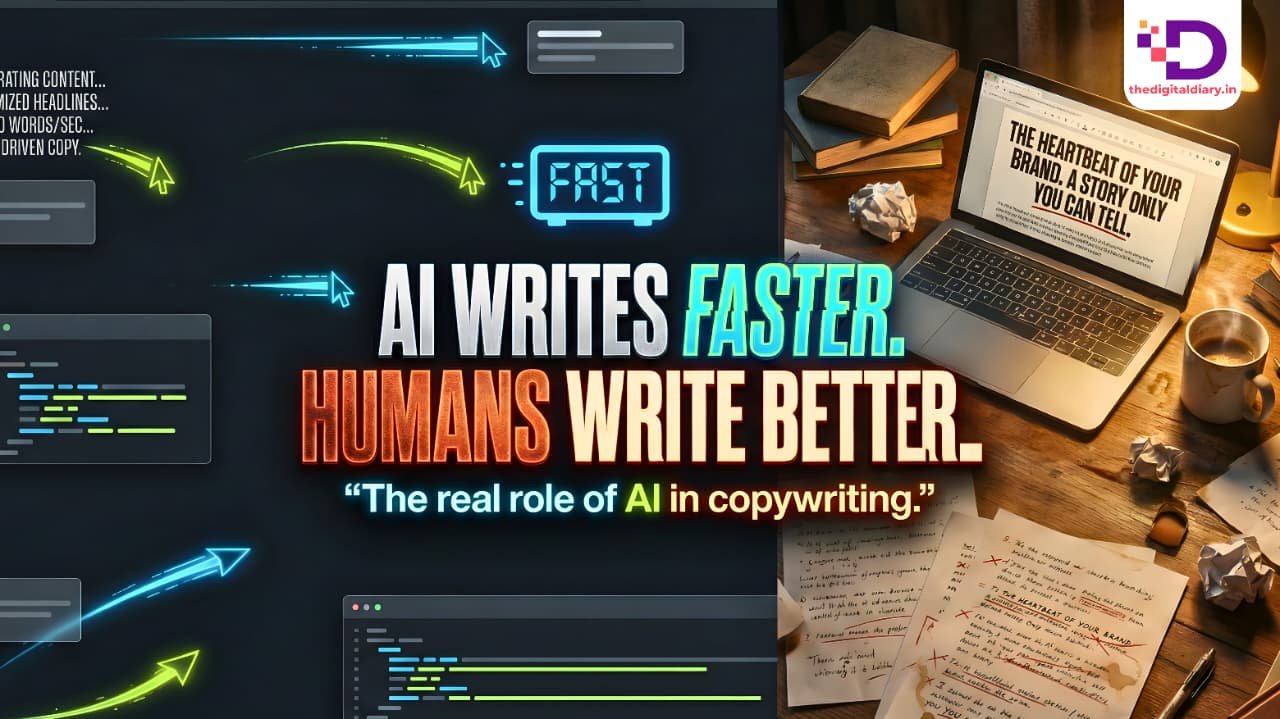
AI does not replace copywriters. It changes what good copywriting looks like.
The strongest writers now spend less time on mechanical tasks and more time on judgment. They decide what matters, what feels credible, and what should never be automated.
AI becomes a sharper pencil, not the hand holding it.
And that balance continues to evolve, shaped by tools, expectations, and the quiet discipline of people who still care about how words land.