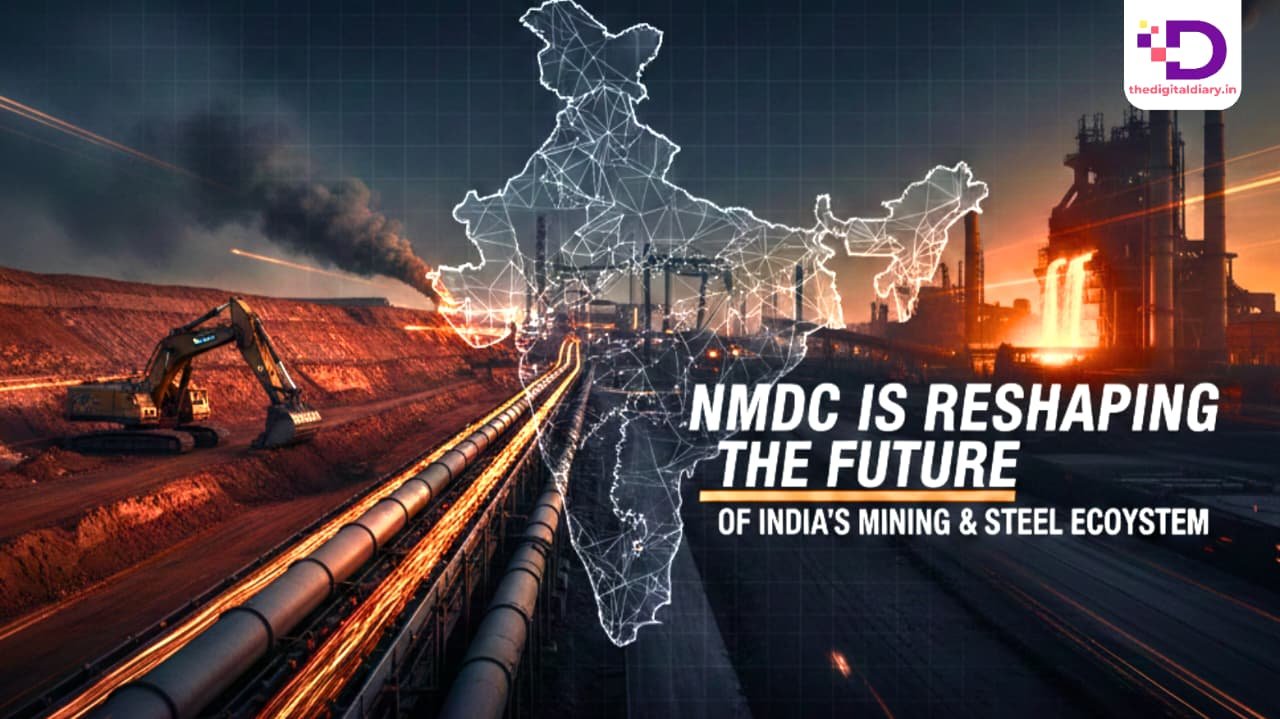
NMDC Limited has entered a phase that feels less like routine expansion and more like strategic repositioning.
The country’s largest iron ore producer is no longer speaking only about output volumes. Its recent direction signals a deeper shift toward resource security, policy alignment, and long-term industrial relevance in a mining sector that is being quietly restructured by regulation, demand, and global supply pressures.
For years, NMDC’s identity rested comfortably on scale. Its mines in Chhattisgarh and Karnataka fed India’s steel industry reliably, and that stability defined its role. Now, the conversation has broadened. The company is actively seeking new mineral assets, pushing for supportive mining policies, and aligning itself with India’s evolving resource priorities.
This is not a cosmetic change. It reflects how the mining sector itself is changing.
A search for new reserves, not just higher output
NMDC’s recent communications and operational focus show a clear intent to secure access to additional mineral resources. Iron ore remains central, but the attention is gradually expanding to other strategic minerals that could become critical for India’s industrial and infrastructure ambitions.
This shift recognises a simple reality. Production capacity matters less if reserve visibility weakens over time. Securing long-term access to raw material has become as important as extracting what already exists.
The company has shown interest in participating in future mineral block auctions and exploring opportunities beyond its traditional footprint. That signals an understanding that mining leadership today requires geographic and resource diversification, not just operational efficiency.
Policy support becomes part of the conversation
Unlike previous years, NMDC’s outlook now openly references the need for policy backing.
Mining in India operates within a framework that is still adjusting to new auction systems, environmental expectations, land access procedures, and royalty structures. As these rules evolve, large state-owned miners such as NMDC are looking for regulatory clarity that allows them to plan investments confidently.
This is where the relationship between miner and policymaker becomes more visible. NMDC’s stance reflects a broader industry sentiment that the next phase of mining growth depends as much on policy design as on geological discovery.
The steel connection changes the equation
Another layer shaping NMDC’s strategy is the emergence of NMDC Steel Limited. With the commissioning of its integrated steel plant at Nagarnar, the company is no longer only a raw material supplier. It now sits at both ends of the value chain.
This changes how the company thinks about reserves, supply stability, and long-term planning. Iron ore is no longer just a product to be sold. It becomes an internal necessity to feed its own downstream operations.
The steel venture has introduced a new urgency to resource planning. Secure mining feeds secure steel production, and that linkage is influencing how NMDC frames its future priorities.
A mining sector under quiet transformation
India’s mining sector has been undergoing structural change for several years. Auction-based allocation of mines, tighter environmental scrutiny, rising domestic steel demand, and the global conversation around critical minerals have altered the landscape.
Within this environment, NMDC’s repositioning appears less reactive and more anticipatory.
The company is not only adjusting to present conditions. It is preparing for a mining environment where access to resources, compliance, and integration with manufacturing will define leadership more than sheer extraction capacity.
Why this moment matters for India’s resource story
India’s infrastructure expansion, urban development, renewable energy projects, and manufacturing ambitions all depend on reliable mineral supply. Iron ore remains the backbone of this system, but the demand for other minerals is growing in parallel.
NMDC’s effort to seek new resource opportunities and advocate for supportive policy frameworks mirrors a national priority. The emphasis is shifting from mining as an isolated activity to mining as a strategic enabler of industrial growth.
In that sense, NMDC’s current posture tells a larger story about how India is thinking about resource security.
A more vocal, future-looking NMDC
What stands out is not just what NMDC is doing, but how it is speaking about it. The language has moved from production reports to forward planning. From operational updates to strategic positioning.
This suggests a miner that recognises its role is expanding beyond extraction into stewardship of resources that will underpin India’s next phase of industrial development.
As mineral demand rises and regulatory structures mature, NMDC’s ability to secure new assets, work within evolving policies, and support its steel ambitions will shape not only its own trajectory, but a significant part of India’s mining future.
FAQs on NMDC’s Mining Activities and Steel Expansion
What are the NMDC mining operations?
NMDC operates some of India’s largest iron ore mines, primarily in Chhattisgarh and Karnataka. Its flagship complexes are in Bailadila (Dantewada) and Donimalai. These mines supply high-grade iron ore to major steel producers across the country and form a critical link in India’s raw material supply chain.
What are the future plans of NMDC Steel?
NMDC Steel is working to bring operations at its Nagarnar facility in Chhattisgarh to steady levels while gradually increasing output. The focus is on improving capacity utilisation, building downstream product capabilities, and strengthening distribution networks to serve domestic and export markets more efficiently.
Which is the largest iron mine in Chhattisgarh?
The Bailadila mining complex in Dantewada district, operated by NMDC, is considered the largest and one of the richest iron ore deposits in Chhattisgarh. It is known for producing high-grade hematite ore that is widely used by Indian steel manufacturers.
What is the vision of NMDC in 2030?
NMDC’s broader vision for 2030 centres on increasing iron ore output, expanding into value-added steel production, adopting sustainable mining practices, and supporting India’s long-term infrastructure and manufacturing ambitions.