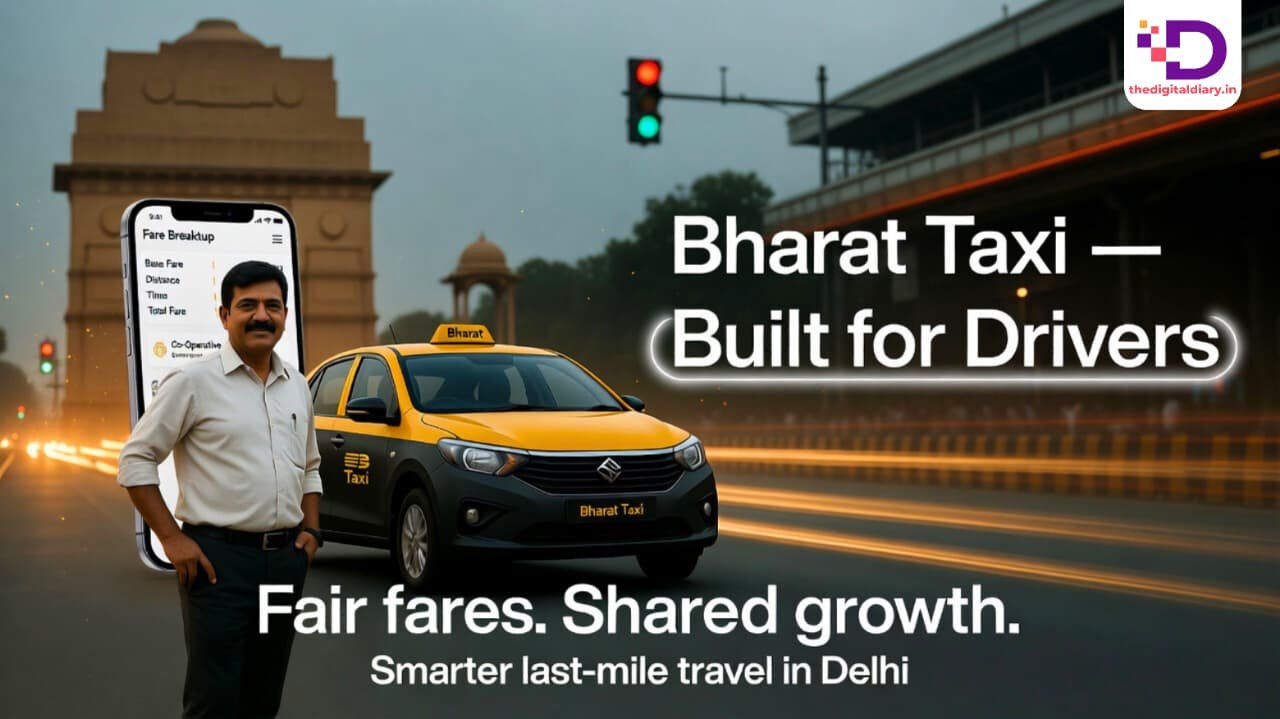
India’s ride-hailing market witnessed an unusual development in New Delhi this week. Bharat Taxi, described as the country’s first cooperative-sector taxi platform, formally entered service with backing from senior government leaders and a model that moves away from the familiar commission structure used by large private apps.
Union Home and Cooperation Minister Amit Shah presided over the launch, signalling official interest in encouraging a homegrown alternative in a market long shaped by companies such as Uber and Ola. For years, drivers across platforms have voiced concerns about rising commissions and opaque fare systems. Bharat Taxi positions itself as a response to those concerns by offering drivers a stake in the platform rather than treating them as independent contractors working at its margins.
The service begins in Delhi and the wider National Capital Region, with plans for gradual expansion into other cities. Those involved in the launch describe the platform as an attempt to rebalance the relationship between drivers, riders and the economics of ride-hailing.
A Cooperative Structure for Drivers
Bharat Taxi does not rely on percentage-based commissions. Instead, drivers, referred to on the platform as “Sarathis”, pay a fixed daily participation fee and keep most of what they earn.
This approach stands apart from the dominant revenue-sharing models that have defined the sector. Drivers often argue that after fuel, maintenance and platform fees, their margins have steadily narrowed. The cooperative structure attempts to change that equation, though its practical impact will only become clear with time.
Drivers present at the launch expressed cautious optimism. Lower overheads are welcome, but the success of the system depends on steady rider demand and a reliable digital experience. Even a fair economic model needs scale to work.
Linking with Public Transport for Last-Mile Travel
One of the early steps for Bharat Taxi is a partnership with the Delhi Metro Rail Corporation. The app will offer last-mile connectivity from selected metro stations through taxis, auto-rickshaws and bike taxis.
In a city where the final stretch of a commute often proves the most frustrating, this integration could make a visible difference. Officials suggest this arrangement may serve as a template for similar collaborations in other cities, combining public transport with app-based mobility.
Transparent Pricing Without Surge
Bharat Taxi promotes clear pricing and the absence of surge fares as central promises. Riders, in theory, should encounter consistent charges regardless of demand spikes, a feature likely to appeal to commuters tired of unpredictable price jumps.
Balancing that promise with driver earnings, however, will be delicate. Stable fares benefit riders, but they must still allow drivers to earn reasonably during quieter periods. Achieving both objectives will require careful calibration.
A Shift in India’s Mobility Conversation
The timing of this launch is significant. Urban mobility in India is under scrutiny as cities grapple with congestion, environmental pressures and gaps in public transport. Ride-hailing apps have offered convenience, but they have also drawn attention to working conditions and the power of pricing algorithms.
In this context, Bharat Taxi represents an attempt to test a different economic framework within the same digital ecosystem. Observers note that fairness of structure alone will not guarantee adoption. The platform must still prove its reliability, ease of use and availability at scale.
Early commuter responses reflect this reality. Some welcome the idea of a more equitable alternative. Others remain loyal to familiar apps whose interfaces, loyalty benefits and wide networks have become part of daily routine.
The Test of Sustainability
For Bharat Taxi to sustain itself, it must attract a critical mass of both drivers and riders. Competitive pricing, dependable technology, strong safety measures and smooth payment systems will all influence whether users return after their first ride.
The cooperative model addresses long-standing frustrations in the ride-hailing industry, especially around commission structures. But market success depends less on theory and more on consistent performance.
As the service begins operations in Delhi, Bharat Taxi becomes more than a new app. It becomes a live test of whether an alternative economic approach can coexist with, and perhaps challenge, the commercial dominance of established ride-hailing giants in India’s cities.