The recent Stripe interview with Google CEO Sundar Pichai outlined a definitive roadmap for the Generative Engine Era. The overarching theme is a total pivot from passive retrieval to active, autonomous task management.
For strategists and technical leaders, the signals are clear. The traditional workflows are breaking down, and a new agentic ecosystem is rapidly taking its place. Here are the five critical shifts defining the immediate future of technology.
1. Search Transitions to an Agent Manager
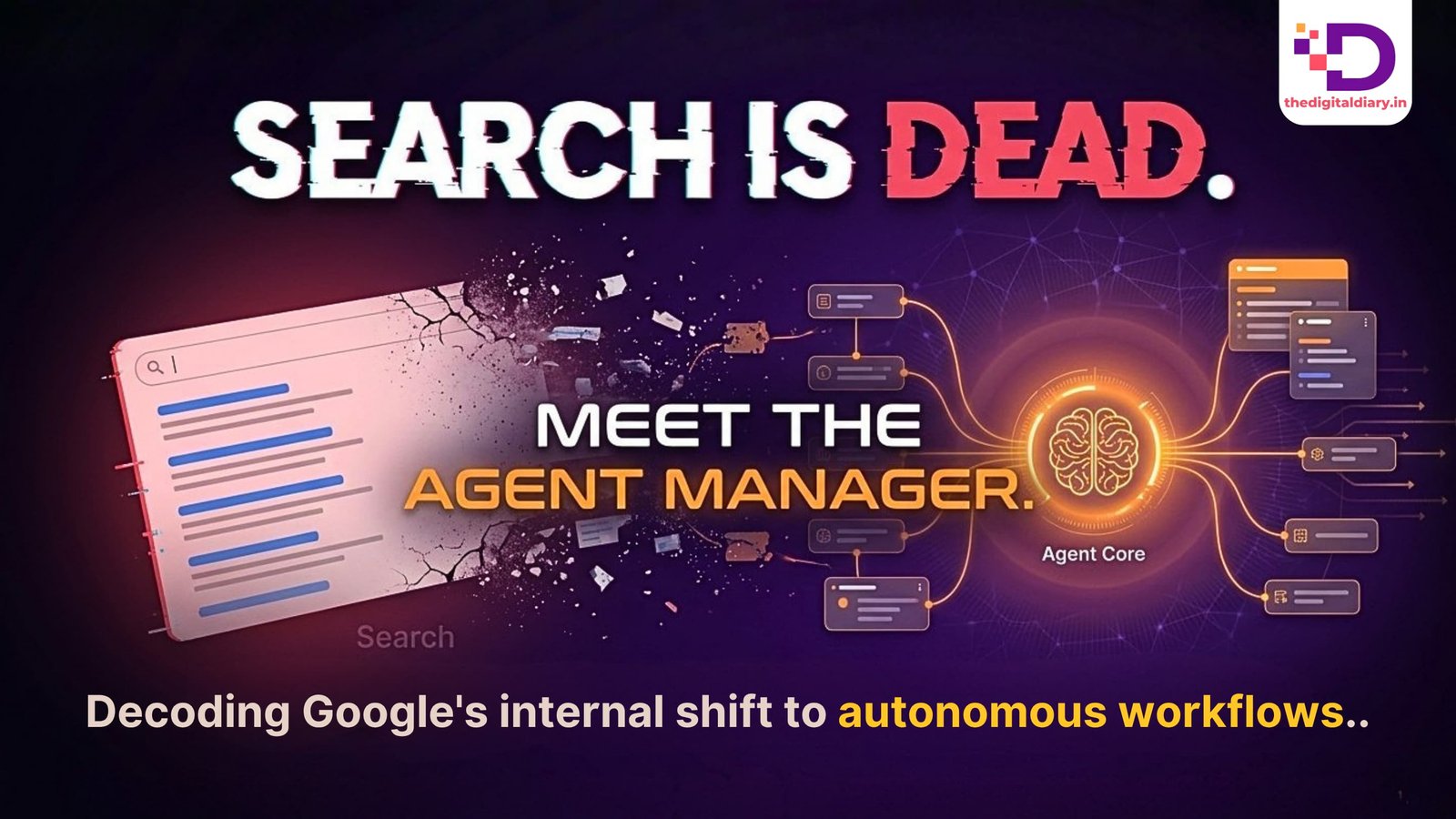
Do not expect the search bar to disappear; expect it to change functions entirely. Information-seeking queries are evolving into complex, agentic workflows.
From Retrieval to Active Delegation
Search is shifting into an "agent manager" role. Instead of returning a static list of links, the engine will process long-running tasks by deploying multiple AI threads simultaneously. Deep research is moving fully into AI mode, transforming the user from a standard searcher into a workflow delegator.
2. Enterprise Adoption of Internal Workflows
Google is quietly restructuring its internal operations around advanced agent managers. The company currently operates an internal version of the Antigravity IDE, codenamed "Jet Ski."
Project Jet Ski and DeepMind Operations
This is not an experimental sandbox. It is the core workflow for Google DeepMind and primary Software Engineering groups. Even the main Google Search team recently transitioned to this agentic infrastructure.
Mandatory Adaptation for Technical Leaders
The strategic takeaway is obvious. If top-tier engineering teams are already living inside agent managers, mastering these workflows today is a mandatory requirement for maintaining a competitive advantage in your own industry.
3. The Resurgence of Hardware and Robotics
AI spatial reasoning has finally caught up to the hardware visions of the past decade. Models like Gemini Robotics are hitting state-of-the-art benchmarks, bridging the gap between digital intelligence and physical execution.
Spatial Reasoning and Autonomous Delivery
Expect massive scale in physical, autonomous infrastructure. Wing drone delivery, for example, is projecting access for 40 million Americans in the near term.
The Strategic Value of First Party Hardware
Furthermore, first-party hardware will remain critical. Controlling the physical product is the only way to secure the safety, regulatory, and feedback loops necessary to build next-generation AI models.
4. Consumer Grade Agentic Systems
The recent virality of open-source frameworks like OpenClaw signals a massive consumer demand for local, persistent AI agents. The future of consumer technology involves full coding models operating invisibly beneath the user interface.
Open Source Frameworks and Local AI
Users will soon command long-running tasks that operate securely between local devices and the cloud. While security, identity, and access remain the final hurdles to clear, the technical primitives for this localized, agentic future are already coming together.
5. 2027 Is the Autonomous Inflection Point
Prepare your roadmaps for 2027. Pichai repeatedly highlighted this specific year as the critical crossover point where agentic systems will likely operate entirely without a human in the loop.
The End of the Human Bridge
The era of the human acting as a "copy-and-paste" bridge between an AI output and a software execution environment is coming to a close.
Post Training Leaps
Improvements in post-training protocols are currently driving exponential jumps in reasoning capabilities, allowing systems to verify their own logic.
Agentic Self Improvement
Systems are reaching the stage where they can execute code, check for errors, and self-correct without explicit prompting. When AI systems learn to improve their own usefulness autonomously, the development curve will accelerate beyond current predictive models. Establish your zero-click, agentic strategy today to prepare for this shift.