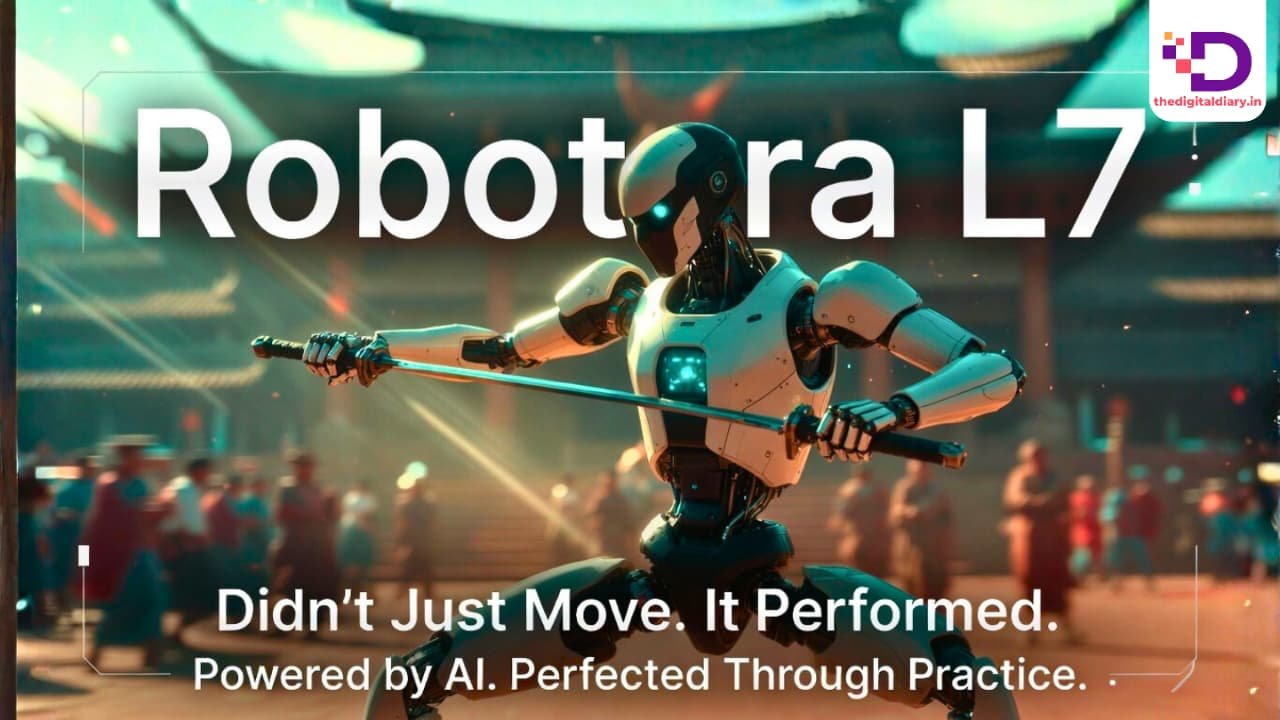
A humanoid robot holding a sword would have sounded like science fiction not long ago. Yet this Lunar New Year, that image became real. Robotera’s L7 humanoid robot stepped forward in traditional costume and performed a Chinese sword dance with movements that felt deliberate, measured, and unexpectedly graceful.
The demonstration was not framed as spectacle alone. It quietly showed how far physical artificial intelligence has progressed. Balance, timing, and coordination, once considered fragile in humanoid machines, appeared controlled and repeatable.
That difference stood out.
Movement shaped through learning, not programming alone
The Robotera L7 humanoid robot did not simply replay a fixed animation. Its performance reflected a system trained to maintain stability while managing an external object. The sword introduced shifting weight, requiring the robot to adjust continuously.
Each step depended on whole-body coordination.
Humans perform such movements instinctively, guided by muscle memory and constant feedback. For robots, the process requires extensive simulation, repeated trials, and careful tuning of control systems. Developers train machines in virtual environments first, where they can fall without damage and learn from failure.
Only later do those lessons transfer into physical motion.
The sword dance revealed that transition.
Observers could see slight pauses between sequences, moments where the robot recalibrated before continuing. Those pauses signalled computation at work rather than hesitation.
A cultural performance becomes a technical demonstration
Chinese sword dance carries symbolic meaning. It combines martial discipline with artistic expression. By choosing this form, Robotera presented more than mechanical ability. It placed its robot inside a cultural tradition that depends on rhythm and intention.
That context mattered.
Robotics demonstrations often focus on speed or strength. This performance emphasised control instead. The robot did not rush. It maintained structure.
That restraint made the technology easier to understand.
Instead of abstract promises about artificial intelligence, viewers could see physical competence developing step by step.
The Robotera L7 humanoid robot reflects wider industry movement
Across the robotics sector, companies are working toward machines capable of operating in human environments. Walking has become more reliable. Grasping objects has improved. Coordinated movement remains one of the harder challenges.
The Robotera L7 humanoid robot’s sword dance suggests that progress is no longer confined to laboratories.
Robots must manage uncertainty. Floors vary. Objects shift. Motion cannot rely on perfect conditions. Demonstrations like this show systems learning to adapt rather than simply execute pre-defined instructions.
That distinction defines modern robotics.
Artificial intelligence now contributes directly to physical behaviour, not just digital tasks.
Why physical coordination remains difficult for machines
Human bodies solve complex problems automatically. Standing upright requires constant adjustment. Holding a tool changes balance instantly. Muscles respond before conscious thought.
Robots must calculate those adjustments explicitly.
Sensors feed information into control systems. Software evaluates position, weight, and movement. Motors respond.
Every step depends on timing.
Small errors compound quickly. Stability disappears.
This is why fluid motion attracts attention.
It signals that the underlying systems have improved.
What the Robotera L7 demonstration suggests about the future
The sword dance does not mean robots are ready for everyday roles. It does indicate growing capability. Machines are becoming more comfortable managing dynamic movement.
That opens practical possibilities.
Factories, warehouses, and service environments require coordination rather than raw strength. Robots must navigate spaces designed for people.
Movement becomes the foundation.
The Robotera L7 humanoid robot offers a glimpse of that transition. Not as a finished product, but as part of a longer process unfolding in public view.
Machines are no longer confined to standing still or repeating rigid actions. They are beginning to move with intention.
And each demonstration brings that shift a little closer to ordinary life.