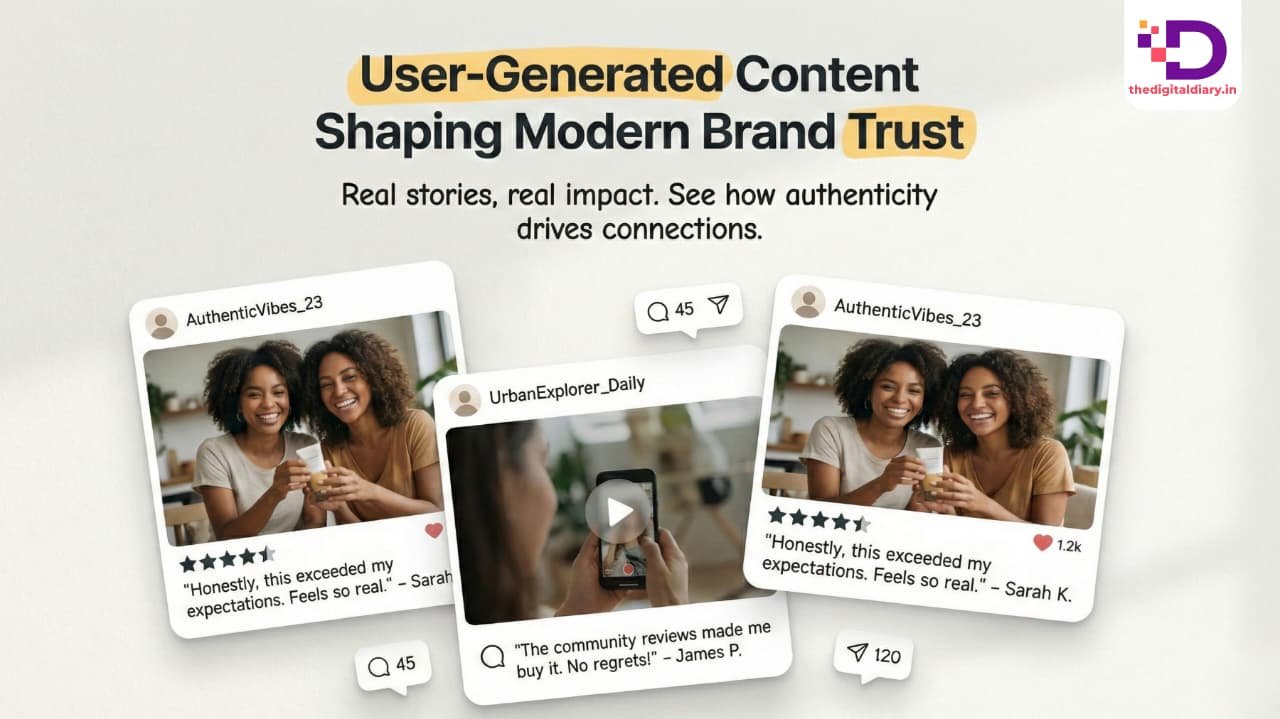
User-Generated Content (UGC) didn’t arrive with a big announcement. It slipped in quietly.
A comment under a post.
A tagged photo.
A short review written on a phone during a commute.
And suddenly, brands had something they couldn’t manufacture.
Trust.
UGC works because it isn’t polished. It isn’t perfect. It feels lived-in. People recognise themselves in it, and that recognition matters more than any high-budget campaign ever could.
This shift shows up clearly in brand storytelling. The strongest pieces rarely start with “we”. They begin with “I tried”, “this helped”, or “here’s what surprised me”. That’s where attention sticks.
Before getting into examples, it helps to ground the idea.
What User-Generated Content (UGC) really means today
At its simplest, User-Generated Content (UGC) is any content created by customers, users, or communities rather than the brand itself. But that definition feels thin now.
UGC has grown teeth.
It influences buying decisions.
It shapes brand perception.
It often outperforms official messaging.
And it shows up everywhere—social feeds, product pages, email campaigns, even paid ads.
When people ask what the types of UGC are, they’re usually thinking of formats. Photos. Videos. Reviews. Testimonials. But the real distinction lies in intent. UGC can inform, persuade, reassure, or quietly validate a choice someone already wants to make.
That’s the part brands sometimes miss.
Example 1: Real customers telling unfinished stories
One of the strongest UGC patterns comes from brands that let customers speak without editing the rough edges away.
Short videos shot in bedrooms.
Casual captions.
Unscripted reactions.
These pieces don’t explain everything. They leave gaps. And those gaps invite the viewer in.
When a user shares how a product fits into their routine—without framing it as advice—it feels observational. Almost accidental. That’s powerful. The content doesn’t sell. It exists. And because it exists honestly, people trust it.
Some brands amplify these stories with minimal branding, sometimes using nothing more than a logo placed quietly in the corner. That restraint signals confidence. No need to interrupt the moment.
Example 2: Reviews that live where decisions happen
UGC works best when it shows up at the exact point of hesitation.
Product pages.
Checkout screens.
Comparison views.
A star rating alone does very little now. The impact comes from specific language. Details. Context.
A line about delivery timing.
A mention of customer support.
A small complaint followed by a reason they still bought again.
That texture matters.
The most effective brands don’t cherry-pick only glowing praise. They allow balanced voices. That balance reads as real. Readers lean in. They imagine themselves having the same experience.
This is where User-Generated Content (UGC) quietly carries SEO value too. Natural language. Long-tail phrasing. The kind of words people actually search for without thinking about keywords.
Example 3: Social challenges that feel optional
Some UGC campaigns collapse under their own enthusiasm. Too many rules. Too much branding. Too much asking.
The successful ones feel lighter.
A simple prompt.
A shared theme.
Room for interpretation.
People participate when they don’t feel recruited. When they can add their own meaning without approval. Challenges succeed when freedom is built into the idea itself.
The brand sets the tone, then steps back.
That pause is intentional.
Example 4: Community posts that answer unspoken doubts
UGC doesn’t always need scale. Sometimes it just needs relevance.
A single post explaining how someone solved a problem using a product can outperform a full FAQ section. Because it speaks sideways. Not instructional. Relational.
This is especially effective in industries where trust takes time—finance, health, education, software. When users explain things to each other, they lower the emotional barrier. They use shared language. They anticipate confusion because they remember having it.
Brands that surface this kind of content show maturity. They understand they don’t need to control every word to guide the conversation.
Where these examples overlap
- It sounds like someone talking, not presenting
- It appears close to the moment of decision
- It keeps imperfections visible
- It values context over polish
That’s four. And enough.
Everything else is execution.
Why UGC keeps outperforming brand content
People don’t distrust brands because brands lie.
They distrust them because brands simplify.
UGC complicates the story in a good way. It introduces nuance. Small contradictions. Personal trade-offs. Those details feel human because they are.
From an editorial perspective, this is why UGC aligns so well with modern SEO. Search engines reward usefulness. Readers reward honesty. UGC tends to deliver both without trying.
And when someone asks again, quietly, what are the types of UGC, the answer keeps changing. Not because formats evolve, but because people do.
New platforms emerge. New behaviours form. The instinct to share stays the same.
That instinct is the story.
And it’s still being written.