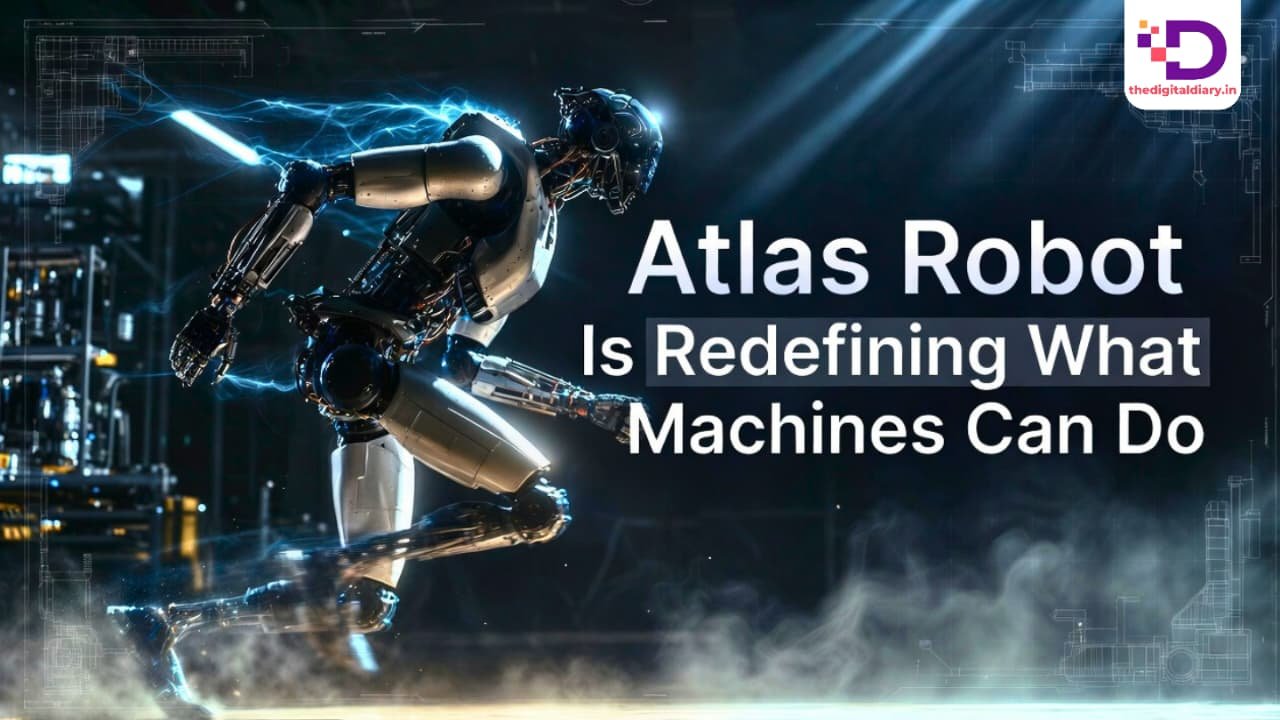
New footage shows Atlas learning complex movements through repetition, revealing how AI training is changing the way robots develop physical skills.
Boston Dynamics has shared a new video of its humanoid robot Atlas, and this time the machine is not lifting boxes or walking through obstacle courses. It is cartwheeling. It is backflipping. And in between, it is stumbling, correcting itself, and trying again.
That last part may be the most revealing.
The demonstration, released as part of what the company describes as a stress test, shows Atlas practising a series of gymnastic movements. Some attempts look almost effortless. Others clearly do not. In one sequence, the robot loses its balance slightly before recovering. In another, it lands more heavily than intended. Yet each attempt feeds into the next.
The robot improves because it practises.
https://www.instagram.com/p/DUdZk4xEakw/
Learning happened long before the physical test
What appears in the video is only the visible stage of a much longer process. Before Atlas ever attempted a cartwheel in the real world, it had already tried it thousands of times inside a simulated environment.
Engineers used computer-based physics simulations to teach the robot how to coordinate its limbs, adjust its centre of gravity, and recover from mistakes. In that virtual space, failure carried no physical cost. The robot could fall endlessly, refine its movements, and try again.
Once those patterns stabilised, the learning transferred to the physical machine.
This approach reflects a shift in robotics. Engineers no longer rely only on direct programming. Instead, they create systems that learn through repetition and correction.
Balance is the real test
The flips and cartwheels attract attention because they look dramatic. But the real focus is balance.
Maintaining stability during a backflip requires constant adjustment. The robot must track its position mid-air, prepare for landing, and shift weight instantly once its feet touch the ground. A small miscalculation can lead to collapse.
Atlas manages that transition more smoothly than earlier versions.
This improvement suggests stronger coordination between its sensors, motors, and control software. Each part responds to the others in real time, rather than waiting for a fixed instruction.
The result looks less mechanical.
It looks responsive.
Why these tests matter beyond the video
Boston Dynamics has spent years using Atlas to explore how humanoid robots might eventually operate in environments built for humans. Warehouses, factories, and disaster areas all present unpredictable physical challenges.
A robot that can regain balance after a slip may continue working. One that cannot will stop.
These demonstrations help engineers understand those limits.
The company has not suggested that Atlas will enter commercial use soon. Its role remains experimental. Even so, the progress offers insight into where robotics may be heading.
The video ends without celebration. Atlas finishes a movement, steadies itself, and stands ready again.
Not as a performer.
As a machine still learning how to move.